Frequency, Pseudoscience and the Semiotics of Resonance
Sound is energy moving through a medium. A string vibrates and displaces the air; a drum membrane trembles; a voice sends waves outward through the atmosphere. When a raindrop strikes a pond, its energy is transferred to the water and travels outward across the surface. The resulting ripple is a wave born from an energetic event: a visible record of an encounter whose force continues to move beyond its point of origin.
Within contemporary wellness culture. Across Instagram, YouTube and the digital marketplace of spiritual self-improvement, “relaxation” music is advertised as vibrating at 432 Hz: the natural frequency, the healing frequency, even the frequency of the universe. Other tones are assigned specialized powers. A frequency of 528 Hz is said to repair DNA; 963 Hz is described as the “Frequency of God.” Sound is claimed to purify water, stimulate plants, activate the pineal gland, awaken consciousness and restore a primordial harmony.
The claims vary, but their presentation is remarkably consistent. A precise number is placed beside an image of a singing bowl, a geometric water pattern, a meditating body or a glowing strand of DNA. Numerical precision gives the claim an aura of measurement. It looks scientific, feels ancient and circulates as though it were simultaneously a musical fact, a biological treatment and a spiritual revelation.
But 432 Hz is not a description of an entire piece of music. It refers to the tuning of one note.
In the prevailing international convention, the A above middle C is assigned a frequency of 440 cycles per second. This is what musicians mean by A=440. It is a reference point from which the other notes of the tuning system are calculated. When an instrument is tuned to A=432, that particular A is lowered by eight cycles per second and the rest of the tuning system shifts downward with it.
Music tuned to A=432 contains no less complexity than music tuned to A=440. It contains fundamental pitches, overtones, chords, percussion, noise, reverberation and thousands of interacting frequencies. Even an A played on a piano, guitar or singing bowl is not a solitary 432 Hz vibration. It is a fundamental surrounded by harmonics that give the instrument its particular timbre.
A continuous, unadorned 432 Hz sine wave would not resemble an angelic choir. It would resemble an electronic test signal or a smoke alarm.
432 Hz is to music what one shade of blue is to an entire painting.
The historical agreement concerning the pitch of A has never been permanent or universal. Before standardized measuring equipment and mass-produced instruments, pitch varied considerably among cities, churches, courts, orchestras and historical periods. Two organs in the same region might disagree. Ensembles tuned according to their instruments, singers and local customs. The modern idea that one exact frequency must govern musical pitch everywhere is itself relatively recent.
Pitch also tended to rise. An orchestra tuned slightly higher could sound brighter and more brilliant than its competitors, encouraging a gradual inflation of concert pitch. What appeared exciting to an audience could be punishing to singers. Higher pitch increased vocal strain and made already difficult operatic roles more difficult to perform. It also increased tension on strings and could make older instruments unstable.
Nineteenth-century efforts to lower and standardize pitch were therefore practical rather than mystical. France established A=435 in 1859. Giuseppe Verdi subsequently supported a consistent lower pitch and expressed a preference for approximately A=432. His concern was the human voice and the absurdity of the note called A changing from one city to another. There is no need to invent a metaphysical Verdi. Protecting singers was reason enough.
A=440 had already been proposed during the nineteenth century. It was recommended internationally in 1939 and later adopted by the International Organization for Standardization. It solved a coordination problem among musicians, orchestras, broadcasters and instrument manufacturers. It did not reveal the true pitch of nature.
A=440 is a convention rather than a cosmic law. But the conventional nature of one standard does not prove that its alternative is sacred. One human agreement is not disproved by inventing another agreement and calling it nature.
There is a second musical history concealed by the obsession with 432 and 440: the history of temperament. Concert pitch determines where the musical map begins; temperament determines the distances among the notes inside that map.
The harmonic series offers apparently simple ratios. An octave vibrates at 2:1, a pure fifth at 3:2 and a pure major third at 5:4. Yet these ratios cannot be extended through every key of a twelve-note keyboard without producing discrepancies. If a tuner constructs a sequence of acoustically pure fifths, it does not return perfectly to its point of origin. The mathematics refuses to close.
Every keyboard temperament is consequently a compromise. Pythagorean tuning preserves pure fifths while producing severe thirds. Just intonation creates exquisite consonance in selected keys but makes movement into other keys difficult. Meantone temperament improves important thirds but concentrates its accumulated discrepancy in remote and sometimes ferocious “wolf” intervals. Well temperaments distribute the impurity more tactically, allowing musicians to play in every major and minor key while preserving different colours and tensions among them.
Bach’s Well-Tempered Clavier explored this newly navigable musical world through preludes and fugues in all twenty-four major and minor keys. “Well-tempered,” however, did not necessarily mean the completely equal temperament found on a modern piano. Bach demonstrated that every key could become musically useful—not that every key should become acoustically identical.
The modern equal-tempered keyboard divides the octave into twelve mathematically equal semitones. This permits unrestricted modulation and transposition. The price of that freedom is that almost every interval, except the octave, is slightly displaced from its pure acoustic ratio.
The well-tempered instrument is not perfectly tuned; it is intelligently compromised.
This history unsettles the fantasy that nature has hidden one perfect musical grid for humanity to discover. Musical systems are negotiations among number, matter, technology, geography and the human body.
Indian classical musicians establish Sa, the tonic, according to the performer and the needs of the performance rather than consulting a universally fixed A. Arabic maqam traditions employ pitches and melodic inflections that cannot be reduced adequately to the twelve equal notes of a piano. Javanese and Balinese gamelan ensembles use tuning families commonly described as sléndro and pélog, but individual sets may possess their own intonational identities. Their instruments are tuned as families. An instrument separated from its ensemble may not agree with an instrument from another gamelan at all.
Here, tuning does not descend from the cosmos as an immutable number. It emerges from a community of instruments.
Even within Western performance, pitch remains alive. Singers, violinists and trombonists continuously shade their intonation according to harmony, direction, expression and the musicians around them. A leading tone may rise toward its resolution; a consonance may settle toward a purer ratio; a blues musician may bend between the piano’s fixed categories. The keyboard freezes a compromise that the voice continues to negotiate.
Imagine travelling back to a Paris café in the 1930s, where Stéphane Grappelli, Django Reinhardt, bassist Louis Vola and the Quintette du Hot Club de France are preparing to play.The original Quintette du Hot Club de France was actually an all-string ensemble—Grappelli’s violin, Django’s lead guitar, two rhythm guitars and Louis Vola’s double bass, with no drummer.There is no glowing electronic tuner clipped to a headstock and probably no discussion of whether the universe prefers 432 or 440 Hz. Someone sounds a note—perhaps Grappelli, perhaps the bassist, perhaps a nearby piano—and the others tune to it. Django adjusts one string against another; the rhythm guitarists tune to Django; Grappelli listens for “beating” between his violin and the emerging centre of the ensemble. The exact pitch might be influenced by the room, the temperature, humidity, the instruments, the strings and whatever reference is available that evening. What matters first is not the numerical identity of A, but whether the musicians agree with one another.
Once they begin playing, that agreement becomes flexible again. Grappelli has no frets beneath his fingers, so every note remains mobile. Django can bend a string, sharpen an attack or pull a phrase momentarily away from the tempered grid. The double bass responds differently according to where and how forcefully it is plucked, while the rhythm guitars create percussion through la pompe, replacing the absent drummer with the physical snap of strings against wood. Their tuning is therefore neither an eternal frequency nor an abstract mathematical system. It is a temporary social relationship—made by ear, continuously corrected through attention and held together for the duration of the performance. The ensemble is in tune because the musicians are listening to one another.
The sonic world is relational before it is numerical.
An even more elaborate numerical mythology circulates under the name of the “Solfeggio frequencies.” The familiar sequence—396, 417, 528, 639, 741 and 852 Hz—is advertised as an ancient system of sacred tones. Each frequency is assigned a metaphysical function: releasing fear, facilitating change, repairing DNA, healing relationships, awakening intuition or restoring spiritual order. Additional frequencies have since been added, including 963 Hz, which is marketed as the “Frequency of God.” Curiously, if the celebrated frequencies are sounded together as a chord, the result is not a lost celestial harmony but a spectacularly unpleasant cluster of unrelated pitches. Apparently, each tone performs its miracle alone; assembled as a family, the sacred frequencies sound as though they urgently require spiritual counselling.
The name gives the system the appearance of musical antiquity. Solfège is real. The modern “Solfeggio frequency” system is something quite different.
Historical solfège developed as a method of teaching singers to recognize musical relationships. In the eleventh century, Guido of Arezzo associated the syllables ut, re, mi, fa, sol and la with the ascending beginnings of phrases in the hymn Ut queant laxis. These syllables helped singers locate, remember and reproduce intervals. They described relationships among notes, not a collection of absolute frequencies.
Medieval singers did not possess electronic frequency counters. The unit called the hertz did not yet exist, and Gregorian chant was not governed by a universal tuning fork calibrated to six exact three-digit numbers. Unaccompanied singers began at pitches appropriate for their voices, their communities and the circumstances of performance.
The modern Solfeggio-frequency sequence did not emerge from measurements of surviving medieval instruments or documented Gregorian performance. It was promoted during the late twentieth century through numerological interpretations, then popularized within alternative-health publishing. Its numerical patterns were treated as evidence of concealed spiritual order. The conclusions came from operations performed upon written digits—not from acoustical archaeology.
A frequency is a physical rate of oscillation. Numerology is a symbolic practice applied to numbers. Either may possess cultural or personal meaning, but one does not scientifically validate the other.
The claim that 528 Hz “repairs DNA” is particularly revealing. DNA is repaired through identifiable biochemical mechanisms involving enzymes, proteins and cellular pathways. Demonstrating that sound contributed to this repair would require controlled biological evidence: specified cells or organisms, calibrated sound intensity, defined exposure, appropriate comparison groups, replicated results and a plausible causal mechanism. Repeating the phrase “love frequency” does not supply that evidence.
Nor does placing a 528 Hz tone underneath ambient music transform the entire recording into 528 Hz. The recording continues to contain a dense spectrum of notes, harmonics, noise and reverberation. Once again, a single frequency is made to stand symbolically for an entire acoustic environment.
The claim that 963 Hz is the “Frequency of God” carries this conversion of spirituality into technical specification to its logical extreme. God is presented not as omnipresent but as oscillating 963 times per second—approximately between B and C in the upper register of a modern piano. A frequency analyzer can verify the tone. It cannot verify the deity.
Higher frequency means faster oscillation, not greater holiness.
Yet the metaphor remains seductive. Western musical and visual languages associate high pitch with height, lightness, heaven and transcendence. Low sounds are described as dark, earthly or bodily; high sounds appear elevated and celestial. The expanded frequency sequence turns this metaphor into a spiritual staircase, placing divinity near its numerical summit.
The number does not measure God. It measures the desire to make transcendence technically legible.
The term “Solfeggio frequencies” therefore performs a double appropriation. It borrows historical authority from medieval sacred music and scientific authority from modern acoustical measurement. Ancient chant supplies mystery; the unit hertz supplies precision. Between them, a contemporary belief system disguises the recent conditions of its own manufacture.
This does not make chanting meaningless. Repetition, controlled breathing, communal singing, sustained vowels and resonant architecture can profoundly affect attention, emotion and bodily experience. Gregorian chant does not require a hidden frequency code to be powerful. Its force may reside in breath, ritual, memory, reverberation, collective intention and the transformation of language into sustained sound.
The pseudoscientific explanation diminishes this complexity. It replaces an embodied cultural practice with a list of marketable numbers.
Solfège teaches relationships among notes. “Solfeggio frequencies” sell imagined properties attached to numbers.
My own interest in alternative tuning began as musical cuiosity rather than an act of faith. About two years ago,I performed a series of live ambient improvisations on YouTube. In some of these experiments I recalibrated ThumbJam, detuned software synthesizers inside Logic Pro and tuned my Roland JX-3P by ear so that the instruments inhabited the same lowered pitch environment. Detuning the instruments changed the conditions of listening. The slightly lowered pitch could affect their colour, weight and relationship to my voice and body. Ear-tuning the JX-3P also introduced small irregularities that no numerical standard could entirely describe. These were real aesthetic differences and worthwhile areas of experimentation. But a preference is not a medical discovery. I could explore A=432 as an artist without claiming that it repaired cells, purified water or brought the listener into closer contact with the universe.
I later tested a selection of YouTube recordings advertised as “432 Hz music” using ThumbJam, an iPad instrument that can be calibrated precisely to A=432. The recordings were pretty, atmospheric and relaxing. There was nothing inherently wrong with the music as music. But none of the samples I tested had actually been tuned down to A=432. When I played along with them, they corresponded to the ordinary contemporary standard of A=440.
The discrepancy was revealing. In these examples, “432 Hz” did not identify an acoustic property of the recording. It identified a market category. The label signified natural, healing, ancient, spiritual and calming, even though the music itself remained tuned to A=440.
The number had ceased to function as a measurement and had become a logo.
The sellers claim that our bodies can recognize the difference between 432 and 440 at a cellular or spiritual level, while apparently assuming that listeners will not recognize whether the recording is tuned to 432 at all.
Cymatics—the study and visualization of patterns produced by vibration—provides some of the most seductive imagery used to support sacred-frequency culture. Sand gathers into geometric figures on vibrating plates. Water produces rings, lattices, stars and flowers. Invisible sound appears to disclose a secret architecture hidden inside matter.
These phenomena are real. The metaphysical captions attached to them usually are not.
A pattern formed on water depends not only upon frequency but also upon amplitude, water depth, viscosity, surface tension, temperature, the size and shape of the vessel, the method of excitation and the boundary conditions at its edges. Change the bowl and the pattern changes. Change the depth and the pattern changes. Change the force of the vibration and an entirely different mode may appear.
A 432 Hz tone can produce an attractive pattern in a suitably arranged apparatus. So can 440 Hz and countless other frequencies. There is no single “perfect ripple” produced by water recognizing a sacred A. There are resonant relationships among particular frequencies, materials and containers.
The vessel is not incidental to the miracle. The vessel helps produce it.
Yet the apparatus is frequently cropped out of the viral image. We see the symmetrical flower, not the adjusted water depth, the selected container, the changing amplitude, the rejected experiments or the many frequencies that also produced beautiful results. The picture does not prove that 432 is sacred. The picture performs the appearance of proof.
Plants complicate the discussion because plants genuinely respond to vibration. They are sensitive to mechanical forces including wind, touch, rain, insect activity and movements transmitted through soil and stems. Experimental work suggests that particular vibrations can affect cellular signalling, gene expression, defence responses and patterns of growth. Plants may respond to the sounds of chewing insects or pollinators because those vibrations carry ecologically relevant information.
But a biological response is not necessarily healing. A change in cellular activity is not automatically beneficial, and evidence that plants respond to mechanical vibration does not demonstrate that they prefer Mozart, singing bowls or A=432. Any effect depends upon the species, intensity, duration, frequency and method by which the vibration reaches the plant.
Sound may eventually have useful applications in greenhouses: monitoring plant stress, discouraging pests or producing carefully controlled mechanical stimulation. That would be precision agriculture, not musical homeopathy.
The plant does not know that it is hearing “healing music.” It encounters pressure waves and mechanical movement.
Sound baths occupy a similarly ambiguous territory. People may genuinely feel calmer, more embodied or less anxious after lying quietly among gongs and singing bowls. This is neither surprising nor trivial. A sound bath provides sustained attention, slower breathing, reduced visual stimulation, resonant sound, ritual, expectation and permission to stop working. These conditions can create a meaningful experience of rest.
The effect need not be imaginary simply because its marketing explanation is false.
Preliminary studies of singing bowls and sound meditation have reported possible improvements in anxiety, tension, mood and some physiological measurements. However, the research is often small and difficult to control. It is not yet clear which effects arise specifically from the instruments and which arise from meditation, rest, social context, expectation or the pleasure of being immersed in sound.
Nor is a singing bowl inherently therapeutic. Its effect depends upon how it is played, how loudly it is struck, its distance from the listener and whether the listener welcomes the experience. At close range, a strongly struck bowl can be startling, painful or overwhelming. Declaring an instrument sacred does not make every use of it safe.
Calling the instrument sacred does not exempt the practitioner from listening.
A sound bath need not cure cancer or repair DNA to possess value. It can regulate attention, encourage slower breathing, mask disruptive noise and create a temporary refuge from overstimulation.
A sound bath may alter consciousness because it gives consciousness somewhere to rest—not because the universe prefers one particular A.
Frequency culture repeatedly confuses three meanings of resonance. Physical resonance occurs when a material system responds strongly to vibration. Aesthetic resonance occurs when an artwork or sound affects us emotionally. Symbolic or spiritual resonance occurs when an experience connects with our beliefs and acquires personal meaning.
These forms of resonance can coexist. They are not interchangeable forms of evidence.
A bowl vibrates the air. A listener becomes calm. The practitioner then claims that the bowl repairs cells. Between those statements lies an unacknowledged leap—the precise point at which aesthetic experience is converted into pseudoscientific merchandise.
The musical layer of RIPPLE enters a different history: the history of ambient, experimental and generative music as an art of duration, attention and environment. From Erik Satie’s idea of “furniture music,” through John Cage’s attention to contingency, Pauline Oliveros’s practice of deep listening and Brian Eno’s conception of ambient music as something that can accommodate different levels of attention, composers have explored sound that does not demand a fixed narrative or a conventional beginning and end. Generative music extends this possibility by creating systems capable of continually producing new combinations. The composer establishes conditions, tendencies and boundaries; the work unfolds within them.
Relaxation music is often dismissed as merely decorative or functional, yet the creation of calm can itself be a serious aesthetic intention. Music can slow the felt passage of time, soften the demand for constant attention and create room for contemplation. Its value does not depend upon inducing the same response in every listener. Nor does it need to disguise itself as medicine. Relaxation is not a frequency hidden inside a recording; it is a possible relationship among sound, environment, attention and the listening body.
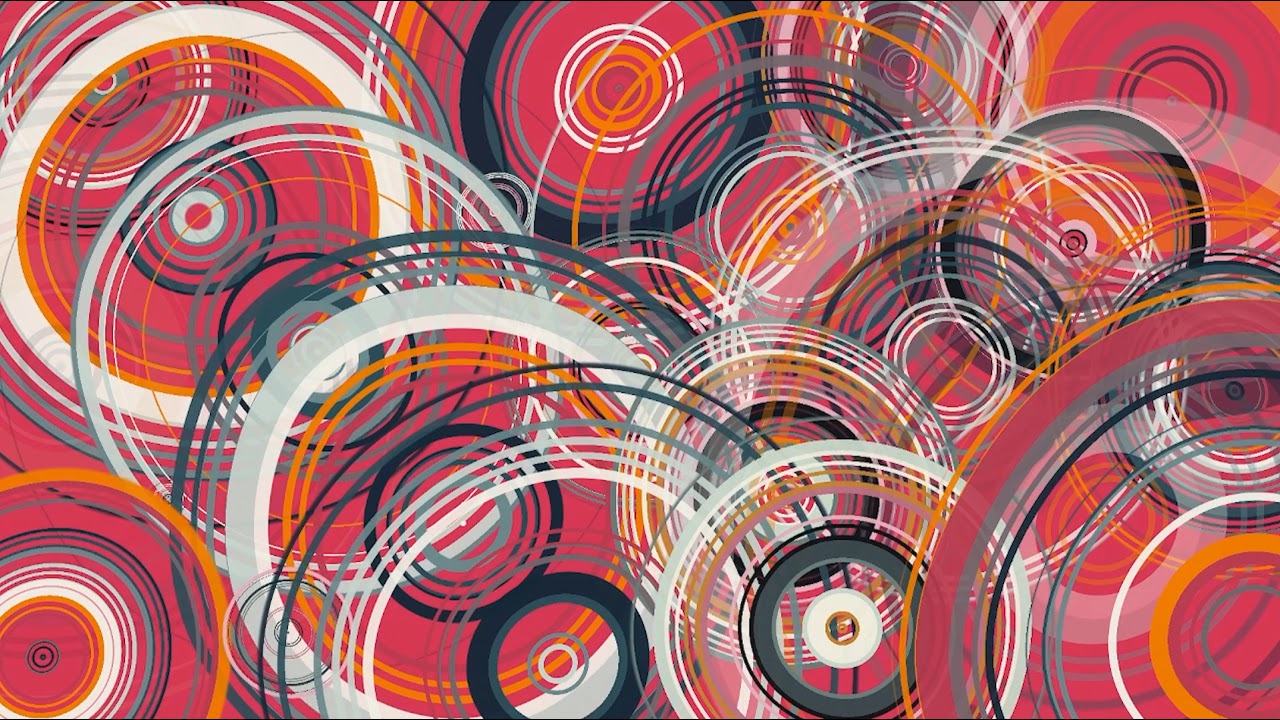
RIPPLE inhabits this territory without remaining conventionally sweet or consistently relaxing. Its musical layer is generative rather than fixed: individual tones appear, overlap, resonate and recede as coloured rings expand across the screen. Although each chord within the composition is sweet-sounding on its own, notes from several chords can accumulate and collide, producing unexpected dissonances. At times the music is delicate and pretty, resembling the clear, rounded tones of a tuned tongue drum; at others it becomes stark, unresolved and quietly disturbing. These emotional textures drift randomly into one another, without a predetermined narrative or stable destination. RIPPLE is never entirely sweet, yet it remains contemplative and slowing. Its consonances and disharmonies open a spacious field in which the listener may pause, breathe, meditate, rest and restore.
The ripple is never produced by frequency alone. It requires a medium, a force, a duration and a boundary. It carries the history of the vessel through which it passes.
There is still mystery here. There is still beauty, altered attention, ritual and wonder. Debunking a false explanation does not debunk an experience. On the contrary, releasing sound from fraudulent certainty permits us to encounter it more attentively—as a physical event, an aesthetic form and a relational process.
RIPPLE does not promise healing. It creates a space in which rest—and perhaps healing—may become possible. Its music does not tell the listener what to feel. It sends a small disturbance outward and waits to discover what the listening body will make of it.
—
Violette Craig Innes
they/them
fka Craig Riddock